AI Metadata Cleaner
A free online tool that strips AI-generated metadata tags from images instantly. Zero backend, zero uploads, zero privacy concerns — everything happens in the browser.
Visit aimetadatacleaner.com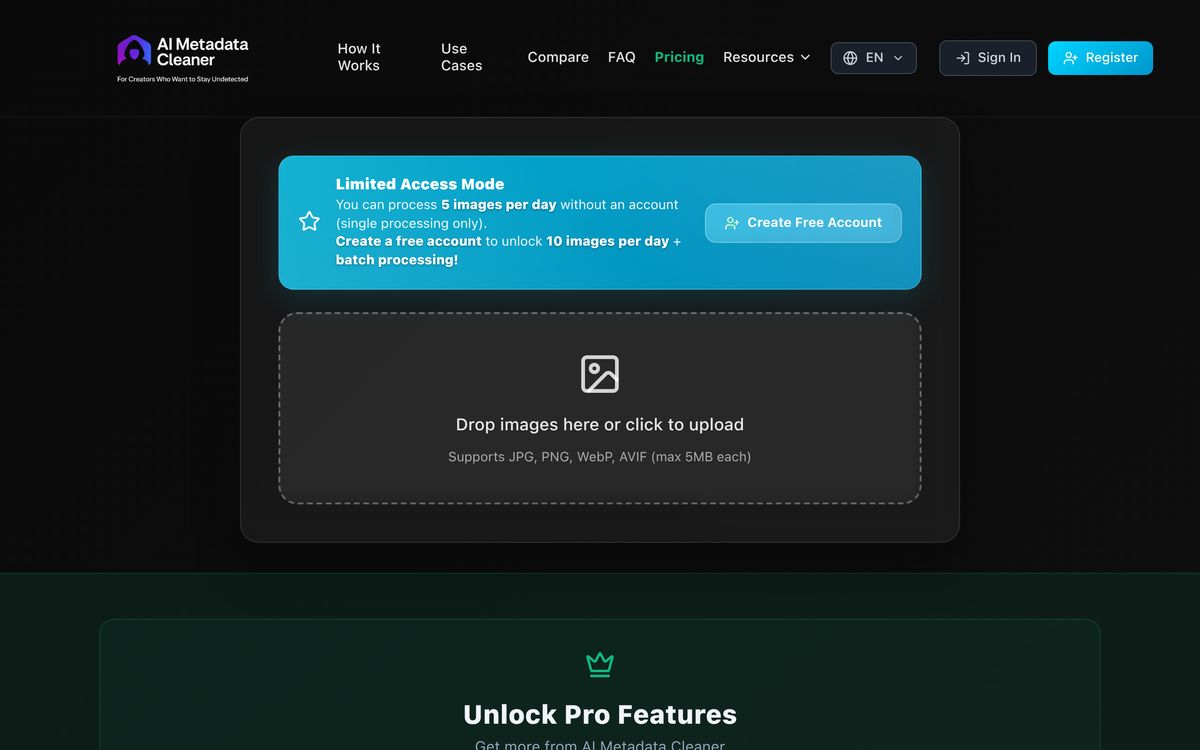
The Problem
When AI image generators like Midjourney, DALL-E, and Stable Diffusion create images, they embed metadata in the file — tags identifying the image as AI-generated, the prompt used, the model version, and other technical details. This metadata persists when you download and share the image.
For many users — designers, content creators, artists using AI as part of their workflow — this metadata is problematic. It can trigger automatic AI detection on platforms, affect how the image is displayed, or reveal workflow details they'd prefer to keep private.
Existing solutions required uploading images to a server. That's a privacy concern — you're sending your images to someone else's computer. For AI-generated content especially, users are sensitive about where their files go.
The Solution
AI Metadata Cleaner processes everything entirely in the browser. No uploads. No server-side processing. No accounts. No data collection. You drag an image in, the JavaScript strips the metadata, and you download the clean file. The original never leaves your computer.
This architectural decision — client-side only — is the tool's primary competitive advantage. It's also why the hosting cost is essentially zero (static files on Netlify's free tier).
Technical Architecture
The tool is built with vanilla HTML, CSS, and JavaScript — no framework. The image processing uses the Canvas API to read the image pixels and re-encode them without metadata. For EXIF data extraction and display, it uses ExifReader.js.
The key technical insight: you can't "remove" metadata from a JPEG/PNG file in the browser. Instead, you read the pixel data, create a new image from those pixels, and export it. The new file has no metadata because you're creating it from scratch. This approach handles all metadata types — EXIF, IPTC, XMP, C2PA — regardless of which AI tool embedded them.
No backend, no database, no API. The entire application is served as static files. This means:
- Zero server costs (Netlify free tier handles the traffic)
- Zero security vulnerabilities (no server to hack, no database to breach)
- Infinite scalability (CDN serves the same files regardless of traffic volume)
- Complete privacy (nothing ever leaves the user's browser)
Why 4:04 Average Time on Site
AI Metadata Cleaner has the highest average time on site in my entire portfolio at 4 minutes and 4 seconds. That's remarkable for a utility tool — most people expect to use a tool and leave quickly.
The explanation is that users process multiple images per session. The tool supports batch processing — drag in several images, clean them all, download individually or as a zip. A user cleaning a batch of 10-20 AI-generated images will spend several minutes on the page, processing and downloading.
This engagement pattern is completely different from a content site. On The Turtle Hub, time on site reflects reading depth. On AI Metadata Cleaner, it reflects tool utility. Both are positive signals, but they represent different user behaviors.
Growth Without Content Marketing
Unlike my content sites, AI Metadata Cleaner didn't grow through blog posts and SEO-optimized articles. It grew through:
- Direct search demand. People Google "remove AI metadata from image" or "strip DALL-E metadata." The tool ranks well for these queries because it directly solves the problem.
- Word of mouth. Users share the tool in AI art communities, Reddit threads, and Discord servers. A free, privacy-respecting tool gets recommended naturally.
- Backlinks from tech sites. Several AI and technology blogs have linked to it as a recommended tool, which strengthens the domain authority.
What This Project Taught Me
AI Metadata Cleaner is the project that convinced me to take custom web development seriously. It demonstrated several principles that now guide my strategy:
- Tools compound differently than content. A blog post can rank well, but a useful tool gets bookmarked, shared, and returned to. The traffic pattern is stickier.
- Zero marginal cost is powerful. Every additional user costs nothing. The tool handles 6,100 monthly visitors on Netlify's free tier. That's the economics of client-side processing — the user's browser does all the work.
- Solve one problem exceptionally well. The tool does one thing: clean AI metadata. No feature creep, no premium tier, no account system. Simplicity is the product.
- Privacy as a feature. Client-side processing isn't just cheaper — it's a genuine competitive advantage. In an era of increasing privacy awareness, "your files never leave your browser" is a compelling value proposition.